
For general information only. Not a substitute for professional medical advice.
Medi Info Hub Logo

Bell's Palsy (Idiopathic Facial Paralysis)
Educational content • Medi Info HubUpdated: 10/19/2026
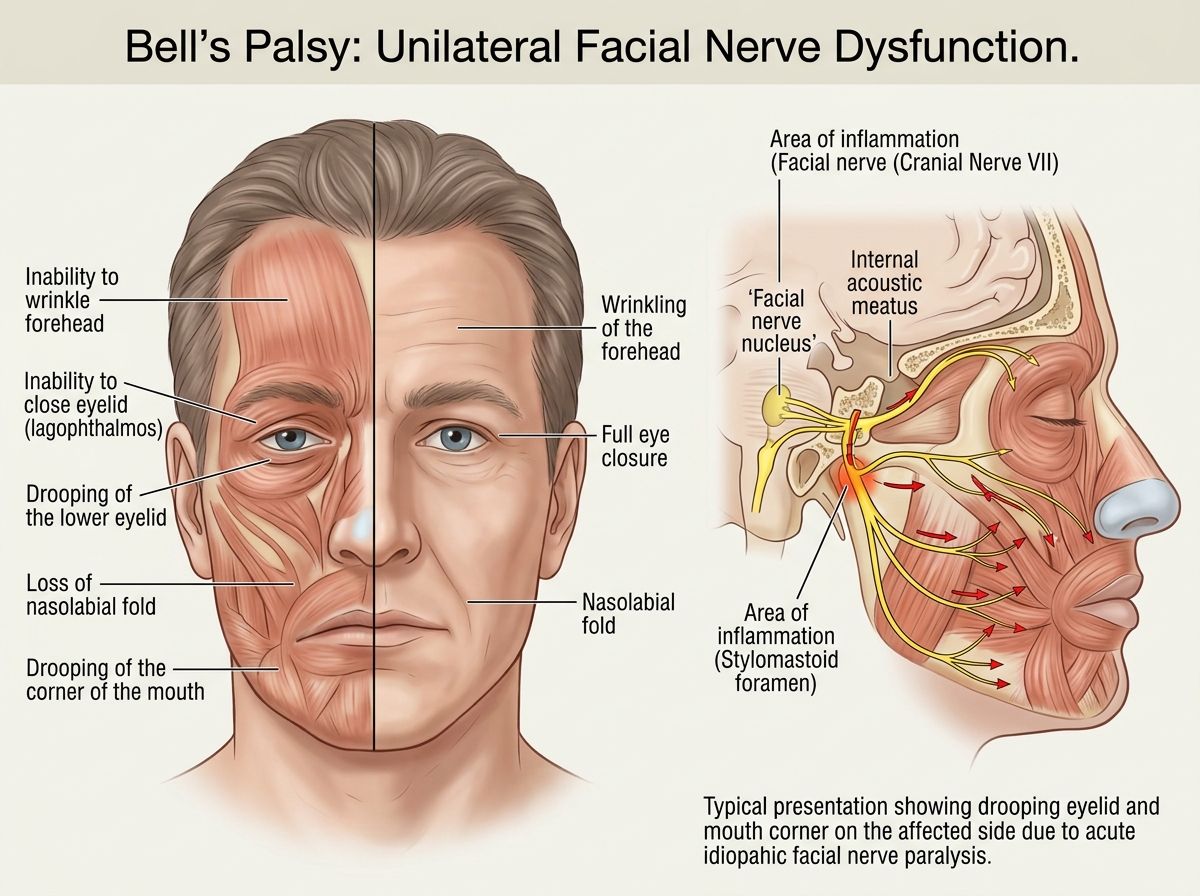
Bell's Palsy (Idiopathic Facial Paralysis) clinical reference photography
Clinical Photographic Reference
Medical Visual GuideNeurology

Bell's Palsy (Idiopathic Facial Paralysis)

Educational photographic and clinical reference illustrating presentation, affected anatomy, or clinical evaluation of Bell's Palsy (Idiopathic Facial Paralysis).

Topic-Accurate VisualClinical Reference

Overview

Bell's palsy is an acute, unilateral peripheral facial nerve (Cranial Nerve VII) paresis or paralysis of sudden onset, resulting in weakness of the facial muscles responsible for expression, eyelid closure, and smiling.

What Is It?

Bell's palsy arises from acute edema and inflammatory compression of the seventh cranial nerve within the narrow confines of the fallopian canal in the temporal bone. It is the most common cause of spontaneous acute peripheral facial weakness.

Signs & Symptoms

Rapid onset (within 48 to 72 hours) of unilateral facial droop, inability to close the eye on the affected side (Bell phenomenon), disappearance of the nasolabial fold, drooping of the mouth angle with drooling, impaired taste sensation (dysgeusia) on the anterior two-thirds of the tongue, and hyperacusis (sound sensitivity).

Causes

Strongly associated with reactivation of dormant viral infections (Herpes Simplex Virus Type 1 or Varicella Zoster Virus) within the geniculate ganglion, causing inflammatory perineural edema and ischemia in the narrow facial canal.

Diagnosis

Diagnosis is clinical, confirmed by complete peripheral facial nerve weakness involving both upper (forehead) and lower face (differentiating it from central stroke, which characteristically spares the forehead due to bilateral cortical innervation). Neuroimaging (MRI) is indicated if symptoms progress beyond 3 weeks or involve other cranial nerves.

Treatment & Management

Immediate administration (within 72 hours of symptom onset) of high-dose oral corticosteroids (prednisone 60 mg daily for 5–7 days with taper) significantly improves recovery rates. Concomitant antiviral therapy (valacyclovir) is often prescribed. Aggressive eye protection (artificial tears, lubricating ointment, and nocturnal taping) is vital to prevent exposure keratitis.

Important: Treatment decisions should always be made in consultation with a qualified healthcare professional. Do not start, stop, or change medications without medical guidance.

Prevention & Risk Reduction

There is no established preventive measure. Prompt early initiation of corticosteroid therapy within 72 hours is the primary determinant of complete nerve functional restoration.

Living With This Condition

Over 85% of patients begin recovering spontaneously within 3 weeks and achieve full or near-full facial symmetry within 3 to 6 months. Facial neuromuscular re-education exercises aid in preventing aberrant regeneration (synkinesis).

When to Seek Medical Help

When to Contact a Healthcare Professional

Do not delay seeking medical care if needed

Seek medical attention immediately if you develop sudden facial weakness to differentiate Bell’s palsy from an acute ischemic stroke.

Emergency Warning Signs

Frequently Asked Questions

How do doctors tell Bell’s palsy apart from a stroke?

In a stroke, the forehead muscles can usually still wrinkle because of dual brain hemisphere innervation. In Bell’s palsy, the whole side of the face including the forehead cannot move.

Will my face return to normal?

Most patients (over 80–85%) regain full facial function within 2 to 6 months when treated promptly with corticosteroids.

Medical Disclaimer

Medi Info Hub provides general health information for educational purposes only. The information on this website is not medical advice and is not a substitute for diagnosis, treatment, or consultation with a qualified healthcare professional. Do not delay seeking medical care because of information found on this website. In an emergency, contact your local emergency services immediately.

Published by: Medi Info Hub TeamLast updated: October 19, 2026